
Perth turf pricing by quality tier
| Tier | Supply only ($/m²) | Supplied & installed ($/m²) | Typical lifespan |
|---|---|---|---|
| Budget | $25–40 | $75–95 | 5–8 years |
| Mid | $40–60 | $95–130 | 10–15 years |
| Premium | $60–100+ | $130–160+ | 15–20+ years |
Supply-only and supplied-and-installed ranges per square metre, compiled from published 2025–26 Australian supplier and industry pricing (Premier Grass, EasyTurf, All Seasons and others). Indicative planning figures for budgeting, not a quote. Lifespans reflect the same supplier tier guides; independent reviewer CHOICE has said a well-maintained premium lawn can reach up to 25 years.
Estimate your Perth job
Enter your approximate lawn area to see a supplied-and-installed price range. This is a planning estimate built from published Australian supplier pricing. Your installer will confirm an exact quote after measuring your yard.
The Perth variable nobody puts in a price table: what you are digging into
Excavation and base preparation are around 30% of a residential job. In most Australian cities that is a fairly flat 30%. In Perth it is not, because the ground genuinely changes character across the metro area and our ten suburbs sit deliberately on both sides of that change.
On the Swan Coastal Plain, the WA Government's soil landscape mapping shows deep dune sand. Success comes back 100% Bassendean System. Hammond Park straddles the Spearwood and Bassendean boundary at roughly 42% and 58%. Ballajura is about 94% Bassendean. Sand digs fast, which helps, but it brings its own two problems. Loose sand still needs a properly compacted structural layer or the surface settles unevenly under foot traffic. And "sand" does not mean "dry": Bassendean B4, which is 20.3% of Success, is mapped as "Broad poorly drained sandplain", underlain "at depths generally greater than 1.5 m by clay or less frequently a strong iron-organic hardpan". Ballajura is 31.5% Joel phase, "Poorly drained depressions". Water moves fast through the sand and then stops when it hits something.
Go east and the job changes. High Wycombe is dominated by sand as a thin veneer over sandy clay, plus Pinjarra units described as sand over "mottled yellow clay". That duplex profile is the one where falls and a deliberate drainage exit stop being optional. Further up, Kalamunda has no coastal plain sand at all: 59.2% Dwellingup 2 phase over lateritic duricrust, 21.4% Murray Valleys system, 17.5% Yarragil 1. Forrestfield sits where three systems meet, with about 41% of the suburb mapped only at coarse system level. And Byford is the most fragmented of the lot, 38 mapped units including 6.5% "disturbed land, urban phase", which is the mapping's way of recording ground that has already been modified.
Two honest caveats. These percentages describe the whole suburb polygon, roads, parks and drains included, not your backyard. And the mapping is regional in scale. Use it to understand why two quotes differ; let the installer's first spade decide what your block actually is.
Line items to look for on a Perth quote
- Excavation depth, in millimetres. Industry practice is roughly 75mm for a lawn and around 100mm where vehicles will run over it. A quote that does not state a depth has not committed to one.
- Spoil removal. The excavated lawn, roots and soil have to leave. On a tight block with a side gate and a wheelbarrow run, that is labour hours, not a rounding error. Ask whether tipping fees are in the number.
- Capping the reticulation. Perth-specific and routinely under-described. Pop-ups and solenoids in the covered area get capped, and the controller station that ran the lawn zone needs dealing with. Say so if a bore feeds the system.
- Base material and compaction passes. Road base or crushed rock, wetted and plate-compacted, then screeded with crusher dust and screeded again. Industry guidance is at least two compaction passes, compacted as hard as achievable.
- Weed membrane. Practice genuinely varies between Australian installers: some include it as standard and some do not. It is a fair question rather than a gotcha.
- Infill rate in kg/m². Standard silica or kiln-dried sand runs around 10 to 15 kg/m², power-broomed in after the lay. Pet jobs usually add zeolite for ammonia odour, priced separately.
- Edge restraint and peg spacing. Pegs at roughly 30 to 40cm intervals on a soil base. On concrete or pavers the method changes entirely to adhesive plus a foam underlay.
- Turf specification, not just a product name. Pile height, backing type and warranty term. Landscape pile typically runs 30 to 45mm; pet turf shorter and denser at around 20 to 35mm.
Everything on that list becomes invisible the moment the grass goes down, which is exactly why it belongs in writing. The stage-by-stage version, with what each stage is for, is in our guide to laying artificial grass in Perth.
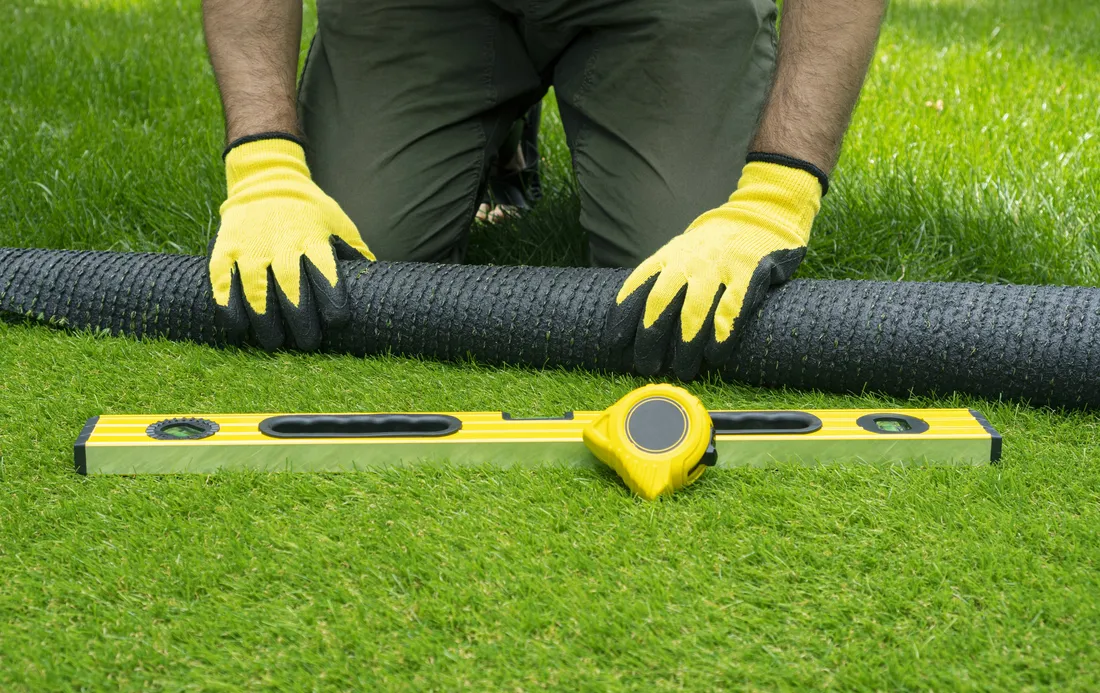
The water side of the ledger, without the rebate fantasy
Perth is the one Australian city where the running-cost argument for synthetic turf is partly a legal one rather than purely a bill one. Under Water Corporation's permanent rules you may run sprinklers on two rostered days a week, once a day, before 9am or after 6pm, and not at all between 1 June and 31 August. Breaches attract $100 on the spot fines. Laying a new natural lawn means applying for a watering exemption that lasts 42 days in the warm half of the year and 35 in the cool half, and Water Corporation warns that the extra water "will result in a higher water bill". The full mechanics are in the sprinkler roster guide.
What we are not going to do is convert that into a tidy annual saving figure, because we do not have a defensible Perth-specific number for household lawn water spend and inventing one would be exactly the kind of thing this site exists to avoid. What we can say plainly is what disappears: the exemption paperwork, the roster, the winter switch-off, the re-turfing cycle, and the water charged to the meter for keeping a lawn alive through 28.7 days a year at or above 35°C.
And to close the door on the most common false hope: there is no artificial turf rebate in WA or anywhere in Australia. Water Corporation's Perth and Peel offers are a toilet rebate and an irrigation rebate, and the irrigation one requires you to "Have an existing irrigation system which has watered your garden within the last 2 years". Removing your retic disqualifies you.
Where else to look
- Artificial grass installation in Perth
- Pet turf pricing and specification
- Turf over an existing slab, and why it prices differently
- What a Bunnings roll costs per square metre, and what it does not include
- Whether your council allows it on the verge
- Turf in Forrestfield
- Turf in Beechboro
- Get a Perth turf quote
Pricing questions we get asked most in Perth
What is a fair per-square-metre price in Perth right now?
Supplied and installed, published Australian supplier and industry pricing puts budget product at roughly $75 to $95 per square metre, mid range at $95 to $130, and premium at $130 to $160 and above. Most standard residential lawns land in the $90 to $130 band. Those are national figures compiled from suppliers including Premier Grass, EasyTurf and All Seasons rather than a survey of Perth installers, so use them to sanity-check a quote, not to argue a tradesperson down to a number they never offered.
Why is the quote for my Kalamunda block higher than my sister's in Success?
Almost certainly the ground and the slope. Success maps as 100% Bassendean System, deep sand, which is straightforward to dig. Kalamunda is 59.2% Dwellingup 2 phase, gravelly sands over lateritic duricrust up on the Darling Plateau, plus Murray Valleys country with steeper sideslopes. Digging a base into laterite gravel is slower work than digging into sand, and sloping ground brings falls and sometimes edging or retaining into the job. Same turf, different excavation.
Should capping the reticulation be a separate line item?
It should at least be named. Nearly every Perth lawn being replaced has retic under it, often fed off a garden bore, and the pop-ups and solenoids in the covered area need capping before the base goes in. It is not an expensive item. It is an expensive omission, because the alternative is cutting the turf open later. Ask specifically what happens to the controller station that used to run that zone.
Does a smaller courtyard cost less per square metre?
Usually more, not less. Mobilising a crew, hiring a plate compactor, minimum material orders and carting spoil away are largely fixed, so spreading them across 20 square metres lifts the effective rate. The consolation is that on a small area, moving up a quality tier costs very little in absolute dollars, which is why courtyards are often where premium turf makes the most sense. This is general trade pricing logic rather than a published Perth figure.
Where does the money actually go?
Industry figures put a typical residential job at roughly 40% materials, 30% base preparation and 30% labour. That means well over half of your money buys excavation, road base, screenings, compaction, edging, infill and hours, not grass. It also explains why a quote that is dramatically cheaper than the others is nearly always cheaper in the part you cannot see once the lawn is down.
How does this compare to keeping a natural lawn?
Two credible framings exist and they point different ways, so here are both. One Australian supplier comparison puts around 50m² of natural lawn at about $1,500 to establish plus roughly $20,000 in maintenance and water across ten years, against $3,000 to $5,000 for an artificial lawn installed with near-zero ongoing spend. Independent reviewer CHOICE, on the other hand, notes that the artificial upfront cost is typically around double a natural lawn's establishment cost. Both are true. Which one matters depends on how long you are staying.
Is any of this GST inclusive?
Ranges published by Australian suppliers are usually quoted as retail figures, but suppliers vary in how they present it and we have not verified GST treatment source by source. Ask your installer to state on the written quote whether the total includes GST. It is a one-line question that removes a 10% argument later.
Turn the range into a number
A vetted local installer will confirm a firm price after measuring the space. Free, and no obligation to accept it.
Get a free, no-obligation quote
Tell us a little about your job and we'll pass it to a vetted local installer.